
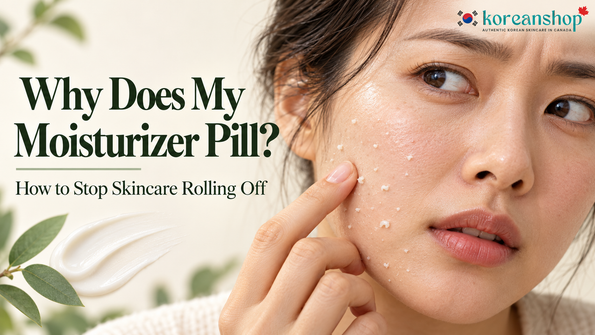
Moisturizer pilling happens when skincare gathers into small rolls or flakes on the surface instead of leaving an even finish. Too much product, repeated rubbing and layers that do not sit well together can all contribute.
You might notice it while applying sunscreen. Your moisturizer looked fine a moment ago, but now little bits are collecting around your jaw. Or your skincare seems smooth until foundation goes on and starts lifting everything underneath.
It is frustrating, particularly when you have spent time choosing products that otherwise feel comfortable on your skin.
Before replacing your moisturizer, look at how the whole routine behaves. The cream may work well alone and struggle only when another product is added. A few changes to application can help you identify the problem without buying an entirely new routine.
For Canadian shoppers adjusting between winter creams, everyday sunscreen and makeup, that is a useful place to start.
What Does Moisturizer Pilling Look Like?
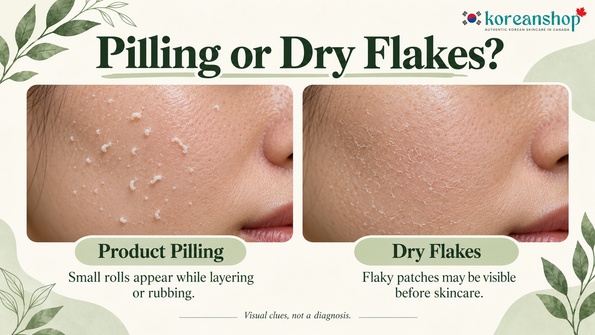
Moisturizer pilling usually looks like tiny rolled-up pieces of product. They may be white, translucent or tinted if foundation is involved.
They often become noticeable as you move your fingers across your face. The finish starts to feel uneven, and small bits collect wherever you have been rubbing.
Pilling does not automatically mean your moisturizer is expired, unsuitable or poor quality. It also does not tell you that none of your skincare has worked.
The important clue is when it begins.
Does your cream roll off when used alone? Does it happen after serum? Or only when you apply sunscreen or makeup?
Noticing that moment gives you something specific to investigate.
Is It Product Pilling or Dry Skin Flaking?
These can look similar, but they call for different responses.
| What you notice | What it may suggest |
|---|---|
| Small rolls appear mainly while layering or rubbing products | Product pilling |
| Rough, flaky patches are visible before skincare | Dryness or peeling |
| Product looks smooth until sunscreen or foundation is added | A layering or application issue |
| Flaking comes with persistent itching, burning or redness | A skin concern that needs attention |
These are clues rather than a diagnosis. Dryness and pilling can also happen together.
Try looking at your skin after gentle cleansing, before applying anything. If the same flaky patches are already present, the problem may involve your skin rather than just the products on top.
Dry skin can feel rough, itchy or uncomfortable. If it remains irritated or becomes painful despite gentle care, speak with a healthcare professional. The American Academy of Dermatology recommends getting help when dryness persists or products cause burning and irritation. Dry-skin guidance.
Why Does My Moisturizer Pill?
There is not one ingredient or application rule that explains every case. These are the main things worth checking.
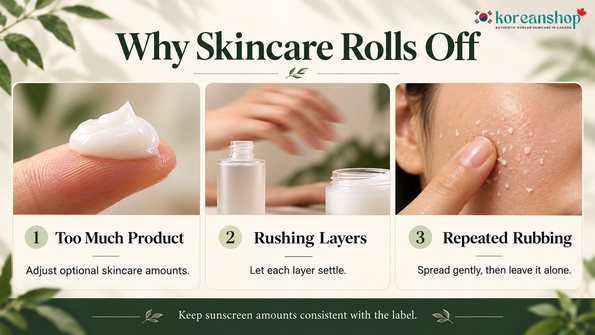
1. You Are Applying More Than the Routine Needs
A generous layer of toner, several drops of serum and a thick coat of cream can leave more material on your face than you intended.
This can happen gradually. You add a little extra moisturizer because your cheeks feel dry, then repeat it across your whole face. Sunscreen and makeup still need to go on afterward.
Too much product is a recognised contributor to pilling. The Ordinary advises adjusting the amount of moisturizer and letting it settle before applying another layer. Moisturizer layering advice.
Use your product’s directions as the starting point. Spread moisturizer evenly, then assess whether an area needs more instead of automatically applying a second full layer.
Do not use less sunscreen to solve pilling. Adjust the optional skincare underneath it first.
2. The Next Layer Goes On Before the Previous One Has Settled
Morning routines can become a race: serum, cream, sunscreen, foundation, then out the door.
If the surface still feels wet or very slippery, the next step may disturb it.
Waiting between layers can help, but you do not need a stopwatch for every product. Give the finish a chance to settle and see whether that changes the result. Eucerin identifies product amount, formula compatibility and time between applications as factors in skincare pilling. Skincare layering guidance.
Try doing another small task after moisturizing, such as brushing your hair, before returning to sunscreen.
If waiting longer makes no difference, keep investigating. Timing is only one possible cause.
3. You Keep Rubbing After the Product Has Spread
Sometimes the application itself becomes part of the problem.
You massage the cream in, check the finish, rub again and then try to smooth away a small roll. More rolls appear, so you keep working at it.
Try spreading the product with a few gentle movements and then leaving it alone. The goal is an even application, not rubbing until there is no trace of a moisturized finish.
Curology notes that pilling can depend on the formula, the amount used and whether products have had time to set. A cream that behaves one way on its own may behave differently under makeup. Pilling and makeup.
4. Two Formulas Do Not Layer Well Together
A moisturizer can feel comfortable at night and still be awkward under your morning sunscreen.
That does not necessarily make either product a bad choice. It may be the combination.
There is no reliable shortcut that identifies every incompatible pair from one ingredient. Seeing silicone, oil or hyaluronic acid on a label is not enough to predict exactly how the finished routine will behave.
Instead, compare the combinations you actually use:
- Moisturizer alone.
- Serum followed by moisturizer.
- Moisturizer followed by sunscreen.
- The same routine with makeup added.
This is a practical comparison, not a clinical test. It helps narrow down the step where the finish changes.
5. Your Morning Routine Has Too Many Overlapping Steps
A hydrating toner, essence, serum, moisturizer and primer may all have a place somewhere in your routine. They do not necessarily need to be used together every morning.
When several layers are involved, it becomes difficult to identify which combination is rolling off.
For troubleshooting, keep the routine simple. Temporarily leave out optional steps while keeping prescribed treatments as directed and maintaining sun protection.
You can reintroduce optional products individually later.
How to Stop Moisturizer Pilling: A Simple Troubleshooting Plan
Change one thing at a time. Otherwise, you may get a smoother result without knowing what helped.
Step 1: Write Down When the Pilling Starts
Make a short note on your phone:
“Cream looks fine. Rolls appear when sunscreen goes on.”
That observation is more useful than “my whole routine pills.”
Include the products used underneath and whether you applied more than usual. You do not need a detailed skincare diary—just enough information to compare attempts.
Step 2: Check the Moisturizer on Its Own
During an evening when your routine allows it, see how your moisturizer behaves after cleansing without optional toner, essence or serum underneath.
Follow any prescribed treatment instructions rather than rearranging them for this experiment.
If the moisturizer sits comfortably alone, avoid replacing it immediately. The issue may involve another layer.
If it rolls off on its own, review the amount and application technique before deciding whether to try a different formula.
Step 3: Bring Back One Optional Product
Add your usual serum or toner back on another occasion.
Keep the moisturizer amount and application method similar. You are trying to compare one change, not several.
If the combination behaves differently, you have found a useful lead. You can try a smaller amount of the optional product, allow it to settle or use it at another time.
Step 4: Check Sunscreen and Makeup Separately
First assess moisturizer followed by sunscreen. Then compare that with a morning when you also wear makeup.
If pilling starts only with foundation or primer, focus on that interaction rather than assuming the moisturizer is responsible.
Try gentle placement rather than repeatedly dragging a brush, sponge or fingers over the same area.
Step 5: Keep the Change That Actually Helps
Once you find a combination that works, give it a fair chance before adding several steps again.
A manageable routine that sits comfortably under sunscreen is more useful than a complicated one you have to repair every morning.
A Simple Morning Routine to Try
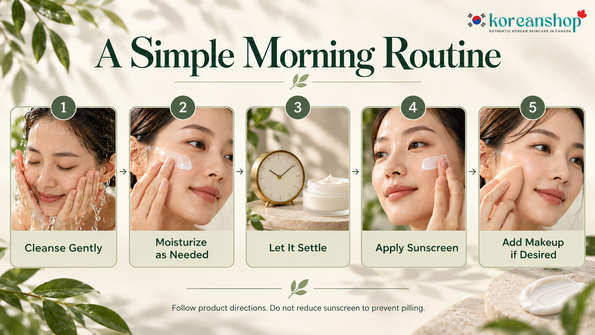
You can use this as a troubleshooting framework, adjusting it for your skin and product directions:
- Cleanse gently. Rinse cleanser thoroughly.
- Apply moisturizer as needed. Spread it evenly without prolonged rubbing.
- Let the finish settle.
- Apply sunscreen according to its label.
- Add makeup once the sunscreen has set.
Keep optional skincare out of this comparison initially. If the routine works, introduce those products individually.
For sun protection, Health Canada recommends a broad-spectrum sunscreen with SPF 30 or higher, applied generously and evenly according to the label. Reapply during exposure as directed, including after swimming or heavy sweating. Health Canada sunscreen guidance.
If your sunscreen visibly rolls off, do not assume the remaining layer provides even protection. When necessary, gently cleanse and restart with fewer products underneath, then reapply sunscreen as directed.
Does Canadian Winter Make Moisturizer Pilling Worse?
Cold weather does not automatically make a moisturizer pill. However, winter can change what you apply.
You may switch to a richer cream, add more hydrating layers or use extra product on dry areas. Those changes introduce new combinations to check.
Winter heating and low humidity can also contribute to dry skin, which may make the finish look flaky even without pilling. AAD information on winter dryness.
The answer is not necessarily to abandon a cream that keeps your skin comfortable. Consider whether it fits better in your evening routine while you troubleshoot the layers used in the morning.
Moisturizer texture should still suit your needs. The AAD notes that creams or ointments can be helpful for dry skin, particularly during winter. Choosing a moisturizer.
Should You Buy a New Moisturizer?
Try the application changes first, especially if you already like how your skin feels.
A new purchase makes more sense when you have identified what you want to change: the texture, finish, package size or how it fits your routine.
At KoreanShop, you can browse the current skincare selection and compare available formats. One smaller option listed is PURITO SEOUL Mighty Bamboo Cream Mini 15ml. A mini format lets you try a smaller purchase before committing to a larger size. View the PURITO mini cream.
It is a moisturizer option, not a guaranteed pilling solution. Whether a product layers smoothly depends on the rest of your routine and how you apply it.
You can also browse KoreanShop’s current selection or contact the store with questions about product sizes and availability.
What Not to Do When Skincare Rolls Off
Do Not Scrub the Rolls Away
Pilling is not proof that your face needs exfoliation.
Adding a scrub or acid may introduce another problem if your skin is already irritated. Exfoliation is not suitable for everyone, and the AAD warns that overdoing it can lead to redness and irritation. Safe exfoliation advice.
Do Not Keep Adding Cream Over the Same Area
If the finish is already rolling up, another layer may make the situation harder to assess.
Pause rather than trying to cover each uneven patch with more product.
Do Not Replace Everything at Once
Changing your cleanser, serum, moisturizer and sunscreen together removes the opportunity to understand what caused the issue.
Work through the routine gradually.
Do Not Ignore Irritation
Small product rolls and burning skin are different concerns.
If you develop persistent redness, itching, peeling or discomfort, seek advice rather than continuing to experiment with additional layers.
Frequently Asked Questions
Why does my moisturizer pill even without makeup?
Makeup is not required for pilling. Check the moisturizer amount, your application technique and any products used underneath. It may also happen with the moisturizer alone.
Does pilling mean my skin is dirty?
No. Pilling alone does not establish that your skin is dirty. Repeated washing or scrubbing is not a useful way to diagnose it.
Should I apply moisturizer to damp skin?
Applying moisturizer after washing while skin is still damp can help with dry-skin care. However, follow individual product instructions, particularly for treatments that require dry skin. Damp does not mean leaving the face dripping wet.
How long should I wait between skincare layers?
There is no single waiting time that fixes every routine. Let the surface settle rather than immediately adding the next product. If extra time does not help, investigate the amount and combination instead.
Can I mix moisturizer with sunscreen to stop pilling?
Apply them separately and follow the sunscreen label. Mixing them yourself is not a reliable way to preserve the sunscreen’s tested application and protection.
Does a pilling moisturizer need to be thrown away?
Not automatically. Check its expiry, storage instructions and any unusual changes, then investigate how it behaves alone and with other layers.
Start With the Routine You Already Have
When moisturizer pills, the most useful first question is where the rolling begins.
Look at the amount, application and combination before replacing products. Try fewer optional layers, avoid repeated rubbing and give each step time to settle.