A pimple finally settles down. The redness fades, the tenderness disappears, and you stop checking it in the mirror.
Then another bump shows up in almost exactly the same place.
If you keep getting pimples in the same spot, it does not automatically mean you are washing your face incorrectly or using the wrong moisturizer. A pore may become blocked again, a deeper bump may not have fully settled, or something that regularly touches that area may be contributing.
Sometimes, the bump is not acne at all.
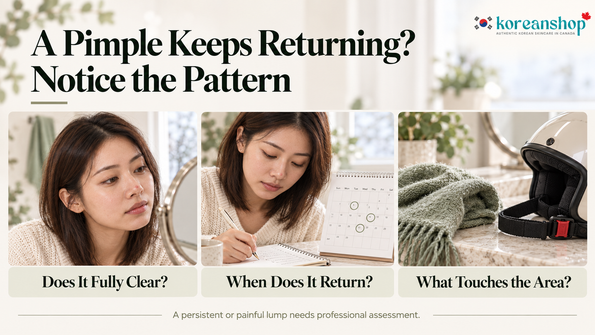
The useful starting point is to notice the pattern: does the area become completely flat between breakouts? Does it flare after shaving? Does it happen around your period? Or is there always a small lump underneath?
Those details can help you decide whether to adjust your routine or get the spot checked.
Why Do Pimples Keep Coming Back in the Same Spot?
Acne develops when hair follicles become blocked with oil and dead skin cells. Inflammation can then lead to a swollen, tender pimple. The NHS explains this process in its acne overview.
The same area can break out repeatedly if the conditions that contribute to acne remain. That might involve blocked pores, hormonal changes, a product that does not suit your skin, or repeated friction.
However, getting several spots across your chin is different from having one lump that repeatedly swells in the exact same place.
A recurring area of acne may respond to a consistent treatment plan. A persistent individual lump deserves a closer look, especially if it never fully disappears.
1. The Original Bump May Not Have Fully Settled
A spot can look much better on the surface while still feeling raised or tender underneath.
If you can still feel a bump, it may be the same lesion continuing to change rather than a completely new pimple. Deeper acne can take longer to settle than a small surface whitehead.
This is one reason to avoid treating every change as a fresh breakout that needs another strong product.
Check the area gently, without repeatedly pressing it. Notice whether it becomes flat between episodes and whether it remains painful.
A lump that repeatedly fills, drains or swells should be assessed rather than squeezed. Skin cysts can look like bumps beneath the skin, and emptying their contents alone may not prevent recurrence. DermNet explains how skin cysts differ from other lumps.
You cannot reliably identify a cyst by looking at it in a bathroom mirror.
2. You May Be Treating Each Spot Without Preventing New Ones
Spot treatment can be useful for certain pimples. But if the same area keeps breaking out, treating only the visible bump may leave the wider acne pattern unaddressed.
For example, you might apply treatment to one chin pimple, stop when it looks smaller, then repeat the process when another appears nearby.
Some acne treatments are intended for the whole acne-prone area rather than individual spots. Others are designed specifically for targeted use. Follow the directions for your product or the plan provided by your healthcare professional.
Do not assume that applying a stronger amount to one bump will work faster.
The American Academy of Dermatology identifies treating only visible acne as one habit that can allow new breakouts to continue. Its guide to habits that worsen acne explains the importance of appropriate, consistent treatment.
If pimples keep appearing in the same spot despite repeated spot treatment, it may be time to review the approach.
3. Picking Can Keep the Area Irritated
It is tempting to check whether a pimple is ready to pop, especially when it has been there for days.
But squeezing, scratching and repeatedly touching the area can prolong irritation. You may end up with swelling, a scab and a dark mark that make the pimples in the same spot seem active for longer.
Picking also increases the risk of scarring.
Try to notice when your hand goes to the area. It may happen while working, watching television or checking your skin in a mirror.
Keep your nails away from the bump and avoid using tools to empty it at home. A pimple does not need to be squeezed to heal.
The AAD recommends keeping hands off acne because picking can delay clearing and increase the risk of marks and scars. See its acne-care tips.
If you have already picked the area, avoid layering exfoliating acids over damaged skin.
4. Hormonal Changes May Be Contributing
Some people notice that breakouts return around a similar time each month, often across the chin or lower face.
Hormonal changes can contribute to adult acne. However, the location alone does not prove that a pimple is hormonal.
A useful clue is timing. Does the breakout tend to appear before your period? Does it happen alongside a broader change in your acne pattern?
Keep a simple record for a few weeks. Note when spots appear, where they occur and whether they are deep or tender. You do not need to track every meal or inspect your face several times a day.
This information can make a conversation with a healthcare professional more useful. The AAD discusses recurring lower-face acne and treatment options in its hormonal acne guidance.
Avoid using online “face maps” to diagnose a hormone problem or an internal health condition from one spot.
5. Something May Be Rubbing the Same Area
Think about what touches the skin where your breakouts appear.
A helmet strap, snug collar, face covering or sports equipment may repeatedly press against one area. Friction, pressure and trapped heat can contribute to a form of acne called acne mechanica.
For Canadian readers, winter clothing is worth checking. If spots appear along the jaw where a scarf sits, repeated contact could be one factor. That does not mean your scarf is definitely causing the breakout.
Look for practical changes:
- Wash reusable items according to their care instructions.
- Change damp clothing after exercise.
- Reduce unnecessary rubbing where possible.
- Check whether straps or collars fit comfortably.
Keep necessary protective equipment in place; adjust fit safely rather than leaving it off.
The AAD explains the relationship between pressure, rubbing and breakouts in its sports-equipment acne guide.
6. Hair Products or Makeup May Be Affecting That Area
Breakouts near the hairline may prompt a different question from breakouts after shaving.
Does a leave-in conditioner touch your forehead? Does hair oil transfer onto your temples? Have you started using a new foundation or heavier styling product?
Some makeup and hair-care products can contribute to clogged pores. Labels such as “non-comedogenic” or “won’t clog pores” can help guide your choice, although individual reactions still vary.
If you suspect a product, change one thing at a time. Replacing your cleanser, sunscreen, moisturizer and makeup together makes it difficult to tell what mattered.
Remove makeup gently at the end of the day and clean your tools regularly. Acne is not a sign that your face needs aggressive scrubbing.
For more detail, see the AAD’s advice on wearing makeup with acne.
7. A Shaving Bump Can Look Like a Pimple
If the bump appears after shaving or plucking, an ingrown hair is another possibility.
An ingrown hair happens when a hair grows back into the skin. The resulting bump may be itchy, tender or similar in appearance to acne.
Check whether the timing follows hair removal and whether the area contains visible hairs. Avoid digging into the skin to search for one.
Gentler shaving habits may help: use shaving gel, shave in the direction of hair growth and avoid repeatedly passing over the same area.
The NHS provides further advice in its ingrown-hair guide.
Other conditions, including folliculitis and perioral dermatitis, can also resemble acne. This is why a repeatedly irritated patch around the mouth should not automatically receive more acne treatment.
Is It a New Pimple or a Leftover Mark?
A flat red, brown or darker patch can remain after a pimple settles. That mark is different from an active raised bump.
Before adding another treatment, ask:
- Is the area raised?
- Is it painful or tender?
- Has a new whitehead appeared?
- Or is the skin flat with a remaining colour change?
A leftover mark does not need to be squeezed or repeatedly dried out.
Trying to remove it quickly with several exfoliating products can irritate the area and make your routine harder to tolerate.
Use sun protection and avoid picking while the skin recovers. If you are unsure whether there is still an active lesion, ask a qualified healthcare professional.
What to Do When Pimples Keep Appearing in the Same Spot
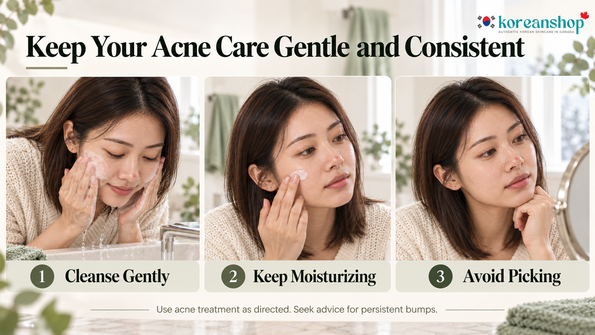
Start with a routine you can follow consistently.
Cleanse Gently
Use a gentle cleanser and lukewarm water. Avoid scrubbing brushes, rough towels and repeated washing because the area feels oily.
Washing more often does not necessarily clear a blocked pore faster.
Keep Moisturizing
Acne-prone skin can still become dry, especially during a Canadian winter or while using acne treatment.
Choose a moisturizer your skin tolerates. If one area is dry, you can adjust the amount there without applying a heavy layer everywhere.
The AAD explains that moisturizer can help skin tolerate drying acne treatments in its acne and moisturizer guide.
Use an Appropriate Acne Treatment
Ingredients such as benzoyl peroxide and salicylic acid can help certain types of acne, but they have different roles and can cause irritation.
Ask a pharmacist or clinician which option fits your skin and follow the product directions. You do not need to begin several acne ingredients together.
If you are pregnant, trying to conceive or breastfeeding, get advice before starting acne medication, particularly retinoids.
Protect Your Skin From the Sun
Use a broad-spectrum sunscreen with SPF 30 or higher and follow its directions. Choose a texture you can wear comfortably alongside your treatment.
Allow Time to Assess the Plan
Acne treatment is not usually an overnight process. The AAD notes that it can take at least six to eight weeks to begin seeing fewer breakouts.
That waiting period applies to a suitable treatment plan—not to an unexplained lump that keeps enlarging or never heals. Read more about acne diagnosis and treatment.
Can Korean Skincare Help With Recurring Pimples?
Korean skincare can provide useful cleansing, moisturizing and sun-protection steps. Its role depends on the individual formula and how your skin responds.
A soothing moisturizer may help your skin feel comfortable while you use acne treatment. A gentle cleanser may make your routine easier to maintain. Neither automatically prevents a deep recurring bump.
When browsing KoreanShop, choose products for a clear purpose rather than adding a full routine because a spot has returned.
Before buying something new, ask:
- Which step do I actually need?
- Does my current product cause discomfort?
- Am I adding another exfoliant to an already strong routine?
- Would this recurring bump benefit more from professional assessment?
A shorter routine that you tolerate is often easier to assess than several new products used together.
What About Pimple Patches?
A basic hydrocolloid patch can absorb fluid from certain surface pimples in the same spot and provide a barrier against picking.
However, patches are not a complete prevention plan. They do not reliably address a deep lump, a persistent cyst or the reason the same area keeps breaking out.
Follow the patch directions and stop using it if the adhesive irritates your skin. Do not squeeze a bump first just to make a patch work.
Cleveland Clinic discusses hydrocolloid patches and the risks of squeezing in its pimple-popping guidance.
When Should You Get a Recurring Spot Checked?
Arrange an assessment if:
- The same lump never fully disappears.
- It repeatedly swells or drains.
- It is deep, painful or leaving scars.
- It keeps bleeding or does not heal.
- You are unsure whether it is acne.
- A consistent, appropriate routine is not helping.
Seek prompt care if you develop rapidly spreading redness, increasing warmth or swelling, significant pain, or fever.
In Canada, a family doctor or nurse practitioner can assess the area and discuss referral when needed. A pharmacist may help with suitable non-prescription acne options, depending on your circumstances.
You do not need to keep trying products until the spot becomes severe.
Frequently Asked Questions
Does a recurring pimple mean my skin is dirty?
No. Acne involves blocked follicles and inflammation, with several possible contributing factors. Harsh washing can irritate your skin without solving the cause.
Why does a pimple return after I pop it?
The area may remain inflamed, the original lesion may not have settled, or the bump may need a different diagnosis. Popping does not address the underlying cause and can increase scarring risk.
Can winter make recurring acne harder to manage?
Winter can make skin drier and less comfortable with certain treatments. Indoor heating and rubbing from clothing may also affect your routine. Adjust for comfort without assuming that every winter breakout needs stronger treatment.
Should I stop moisturizer if I keep breaking out?
Not automatically. Review the formula and how your skin responds. A suitable moisturizer can remain useful, especially if acne treatment causes dryness.
Can I prevent every pimple in the same spot?
No routine can guarantee that. Consistent care may reduce acne, while persistent individual bumps need assessment to identify the right approach.
Pay Attention to the Pattern
When pimples keep appearing in the same spot, the most useful question is whether the skin fully clears between episodes.
Notice timing, shaving, product changes and repeated friction. Keep your routine gentle, avoid squeezing and give appropriate treatment time to work.
If one lump keeps returning—or never really goes away—have it checked instead of repeatedly treating it as an ordinary pimple.