

You finally get a pimple to calm down, but the red marks after pimplest it leaves behind seems to stay. The bump is gone, yet the mark is still easy to notice when you look in the mirror. It can feel like the breakout never really ended.
A flat red or pink spot after acne can be a lingering colour change. It is not always a permanent acne scar, and it may fade with time. Gentle skincare, sun protection and avoiding picking can help you care for the area while it settles. An active ingredient such as azelaic acid may also fit some acne routines, but it cannot promise to erase every red mark.
Why can pimple marks stay red?
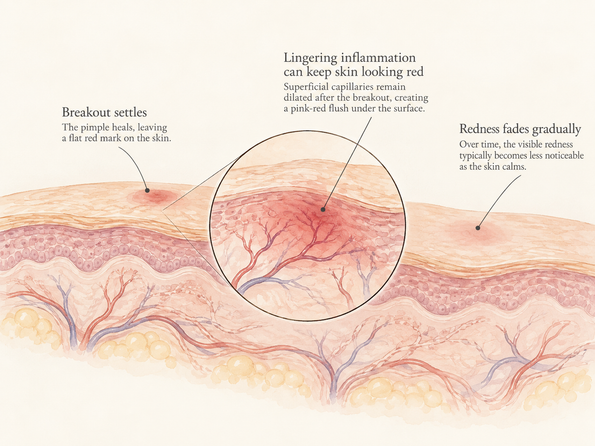
Acne can trigger inflammation in the skin. Even after the raised pimple has gone down, redness may remain as the area recovers. Some post-acne redness is associated with lingering inflammation and changes in small surface blood vessels. A systematic review describes post-acne erythema as a common result of acne inflammation and notes that there is no single gold-standard treatment for every case. Systematic review: Post-acne erythema treatment
The American Academy of Dermatology notes that people with lighter skin may see a red spot where acne was, while people with medium-to-dark skin may see a darker spot. These marks can linger for months. AAD: 7 reasons to treat acne early
The mark may seem more noticeable or take longer to settle if:
- The original pimple was swollen or inflamed.
- You picked, squeezed or repeatedly touched it.
- New breakouts keep forming nearby.
- Your skin becomes irritated from harsh products or too much exfoliation.
- Sun exposure makes a darker post-acne mark more visible.
A mark’s colour and texture can help you decide what question to ask, but they cannot diagnose the cause on their own.
Is it a red marks after pimples, a dark spot or an acne scar?
Not every mark left after a pimple is the same. A flat spot can be red, pink, purple, brown or darker than the surrounding skin. A scar changes the surface texture.
- A flat red or pink mark may be lingering redness after inflammation.
- A flat brown, purple or darker mark may be post-inflammatory hyperpigmentation, a colour change that follows inflammation.
- A dip or raised area may be an acne scar because the skin’s texture has changed.
It is possible to have more than one type of mark at once. If you are unsure, or if the area is painful, warm, growing or changing, get advice from a healthcare professional instead of trying to identify it from a photo or product description.
What can help red marks after acne?
There is no overnight shortcut, but a few steady habits can support skin as it recovers.
1. Avoid picking and squeezing
Picking can create more irritation and inflammation. That can prolong healing and increase the chance of a lingering mark or a scar. If you notice yourself touching a spot, try to leave it alone and keep your hands away from your face.
The Canadian Dermatology Association also advises against picking and squeezing acne, as it can worsen the spot and increase scarring risk. CDA: Acne
2. Keep cleansing gentle
Wash your face with a mild cleanser and lukewarm water. Use your fingertips rather than a rough cloth, cleansing brush or scrub. Pat your face dry instead of rubbing it.
Washing more often or scrubbing harder will not make a red mark disappear faster. Over-cleansing can irritate the skin and make the area feel more uncomfortable.
3. Use a moisturizer that feels comfortable
A moisturizer can help keep skin comfortable, especially if your routine includes acne products that leave it feeling dry. Choose a texture you can use consistently. If a product stings every time you apply it, pause and simplify your routine.
You do not need to layer several soothing products on top of one another. A basic cleanser, moisturizer and sunscreen can be a good starting point while your skin settles.
4. Apply sunscreen during the day
Sun exposure can make some post-acne marks, particularly darker marks, more noticeable. Use a broad-spectrum sunscreen during the day and reapply according to its label when you spend extended time outdoors.
Choose a formula you are comfortable wearing. If a sunscreen feels too heavy or irritating, try another suitable option rather than skipping sun protection altogether.
5. Give the skin time
Redness after a pimple can fade slowly. The timeframe varies, and a product cannot guarantee that a mark will disappear by a particular date. Try to avoid changing your routine every few days. Introduce one new product at a time and pay attention to how your skin responds.
Could azelaic acid help?
Azelaic acid is used in acne care. The American Academy of Dermatology lists it among ingredients that may help with acne and dark spots that remain after acne clears. That is useful context for people who have active blemishes as well as uneven-looking tone. AAD: Adult acne treatments
However, a red mark and a brown or darker mark are not necessarily the same thing. Evidence about treating post-acne redness is not identical to evidence about treating dark spots, and a systematic review found no single gold-standard treatment for post-acne erythema. So it is better to describe an azelaic acid serum as one possible skincare step—not as a guaranteed way to fade red marks.
The ANUA Azelaic Acid 10 Hyaluron Redness Soothing Serum is a 30 ml serum listed by KoreanShop with 10% azelaic acid. Its product information describes a formula for redness and blemish-prone skin. You can view the Anua serum at KoreanShop.
The serum may be worth considering if you want to add azelaic acid to a routine for acne-prone skin. It will not suit everyone, and the product page’s description does not mean every kind of post-acne mark will respond the same way. Check the current ingredient list and directions before use.
How to introduce the Anua serum
Follow the directions on the product packaging and KoreanShop listing. The listing recommends starting with one or two applications per week and increasing gradually as your skin tolerates it. Anua’s product guidance also says to begin with a small amount and increase frequency gradually. Anua product directions
A cautious introduction can look like this:
- Patch test first. Apply a small amount to a limited area and watch for irritation before using it more widely.
- Begin slowly. Use it at the starting frequency listed for the product. Do not increase use just to chase faster results.
- Keep other active products steady. Avoid introducing a new retinoid, exfoliating acid or acne treatment at the same time. This makes it easier to notice what your skin tolerates.
- Follow with moisturizer. Keep the rest of the routine simple.
- Stop if irritation persists. Ongoing burning, swelling, rash or worsening discomfort are reasons to stop and seek professional advice.
A simple morning routine
- Cleanse gently, or rinse with water if that is more comfortable for your skin.
- Apply moisturizer if needed.
- Finish with broad-spectrum sunscreen.
A simple evening routine
- Cleanse gently and let your skin dry.
- Apply the serum as directed on the product label.
- Follow with moisturizer.
If you already use prescription acne medication or other strong active products, ask your doctor or pharmacist before combining them with a new serum. Do not stop a prescribed treatment without speaking with the person who recommended it.
Common mistakes that can keep skin irritated
When a red mark is bothering you, it is easy to add more products or use them more often. That can backfire if your skin becomes irritated.
- Scrubbing the mark: friction can make the area sore without removing the colour change.
- Picking the original pimple: this can worsen inflammation and delay healing.
- Starting several active ingredients together: if irritation appears, it becomes hard to tell which product caused it.
- Expecting a quick fix: post-acne redness does not follow a predictable overnight timeline.
- Treating every mark the same way: a red mark, a brown spot and a textured scar may need different approaches.
- Ignoring ongoing acne: repeated breakouts can leave new marks before older ones fade.
If your routine starts to sting or burn, pause new products and simplify your steps. Persistent irritation is a sign to seek advice rather than pushing through.
When should you speak with a dermatologist?
Consider getting professional advice if:
- Your acne is deep, painful or keeps returning.
- You are developing scars or many lingering marks.
- The redness is spreading, worsening or not behaving like a flat mark after acne.
- Your skin burns, flushes or stays irritated despite simplifying your routine.
- You are unsure whether the mark is acne-related.
A dermatologist can help distinguish acne, post-acne marks, scars and other skin conditions. That can prevent you from spending time on products that do not match the concern.
Frequently asked questions
Why do pimple marks stay red after the bump is gone?
The pimple’s inflammation can settle before the surrounding colour does. Red or pink marks can linger for months for some people. Their duration varies.
Are red marks after pimples the same as dark spots?
No.red marks after pimples can have different causes. Azelaic acid is listed by dermatologists as an option for acne and dark spots, but that does not guarantee it will fade every red mark.
Can Anua Azelaic Acid 10 Serum help red marks?
The serum is marketed for redness and blemish-prone skin and contains 10% azelaic acid. Dermatology guidance supports azelaic acid for acne and post-acne dark spots, while evidence for post-acne redness is less definitive. Results vary.
How often should I use the Anua serum?
Follow the current product directions. KoreanShop recommends beginning with one or two applications per week and increasing gradually if your skin tolerates it.
Will sunscreen make a red mark disappear?
Sunscreen does not erase a mark. It helps protect skin from UV exposure, which can make some post-acne marks more noticeable, especially dark spots.
Can I use the serum with my acne medication?
It depends on the medication and your skin. Ask your doctor or pharmacist before adding a new active serum to a prescription routine.
Is a flat mark a permanent acne scar?
Not necessarily. A flat area of colour is different from a scar that changes skin texture. If you are unsure what you are seeing, ask a dermatologist.
Give your skin a calm, consistent routine
A pimple can go away before its redness does. Avoid picking, keep cleansing gentle, moisturize when needed and use sunscreen during the day. If you want to try azelaic acid, the Anua serum is one option to review—but introduce it gradually and keep expectations realistic.
If acne is painful, persistent or leaving scars, seek professional advice. The right plan depends on what is causing the marks and how your skin responds.