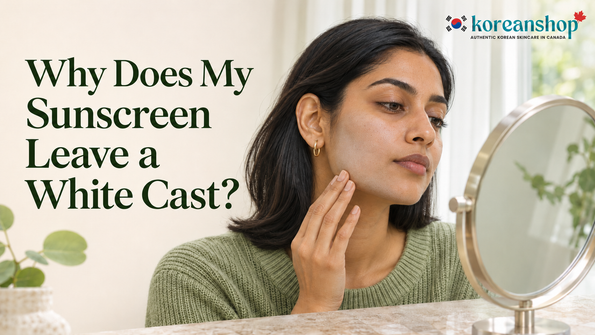
You finish putting on sunscreen, check the mirror and notice a pale line around your hairline. Your cheeks look a little grey, and the sunscreen you thought had blended in is suddenly obvious beside your ears. sunscreen white cast especially frustrating when the product looked fine in a quick swatch on your hand.
If you’re wondering, “Why does my sunscreen leave a white cast?” the short answer is that the formula leaves a visible film on your skin. It’s common with some mineral sunscreens, and the same film can look chalky on one person and barely noticeable on another. A tint can help, provided it suits your skin tone.
Before replacing your sunscreen, take a look in daylight after it has had time to settle. Check whether you’re seeing an even pale film, a few streaks or little bits of product rolling off. Each points to a different fix.
What Does Sunscreen White Cast Look Like?
White cast is the pale, grey or ashy finish some sunscreens leave after you spread them. You might see it across your cheeks, or only notice it where your face meets your neck. It can show up around your eyebrows, hairline and beard, too.
A white lotion coming out of the tube doesn’t tell you how it will look on your face. Some formulas look white while you’re spreading them and become less visible as they settle. Others leave a film you can still see when you step outside.
The colour of that film doesn’t tell you how much UV protection you’re getting. Check the label for SPF and broad-spectrum protection, and follow the application directions. If you find a formula with a finish you like, you’ll have an easier time wearing the full amount. Health Canada’s sunscreen guide
Why Some Sunscreens Leave a White Cast
The mineral filters can leave a visible film
Zinc oxide and titanium dioxide are mineral UV filters. In some formulas, they leave a pale finish that remains visible after application. That’s why two sunscreens with the same SPF can look quite different on your skin. The rest of the formula affects the finish, too. CDC sunscreen guidance
If you like how mineral sunscreen feels, you can compare different formulas within that category. A tinted mineral sunscreen may suit you better than the untinted one you’ve been using. You can also compare it with a transparent fluid or gel if your priority is a finish that’s less visible. Judge the product at the amount you’ll actually wear, since a tiny swatch can make almost any formula look easier to blend.
A pale film shows up differently on different skin tones
On fair skin, white cast might look like a light powdery finish. On medium, olive, brown or deep skin, the same film can appear grey or ashy. Sometimes the first place you notice it is along the jaw, where the colour change is easier to see.
That’s also why a review saying a sunscreen “blends right in” may be hard to apply to your own skin. If you’re looking at swatches online, find someone with a similar skin tone and look for a full-face application in daylight. A photo taken straight after blending can miss how the product looks once it has settled.
The tint may be the wrong shade
Tinted sunscreen can make a pale film less noticeable. The shade still has to work for you. A light beige tint can look ashy on deeper skin, and a warm tint can look orange on someone with cooler undertones. Even two products labelled “medium” can look quite different.
Try a sample along the jawline if one is available. Check it in daylight after it settles, then compare it with the skin on your neck. The American Academy of Dermatology suggests choosing a tint that matches your skin tone to help avoid visible residue. AAD guide to choosing sunscreen
The product may be collecting in certain areas
If the sunscreen looks fine across your cheeks but leaves a white line at your eyebrows or beside your nose, look closely at where the product gathers. It may be catching in facial hair or sitting more thickly in a crease.
Try spreading the sunscreen in smaller sections. Dot it across your forehead, cheeks, nose and chin, then spread it evenly across the exposed skin. Pay attention to the edges near your ears and hairline. Use the full amount directed on the label. Dividing it into sections can make it easier to see where it has landed and where you’ve missed a spot.
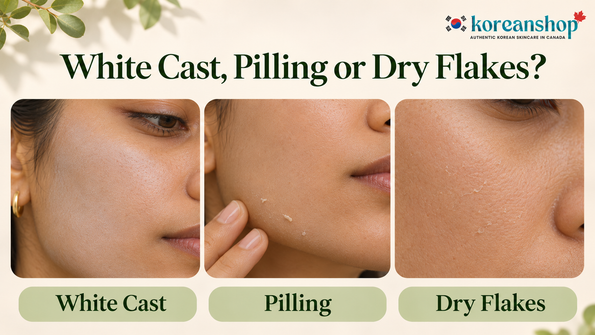
Is It White Cast, Pilling or Dry Flakes?
All three can look white in the mirror, but they behave differently.
| What you see | What it may be | What to try |
|---|---|---|
| An even pale or grey film that remains after the sunscreen settles | White cast | Compare a different finish or a tint closer to your skin tone. |
| White lines around the brows, hairline or beard | Product collecting in one area | Spread the full amount more evenly in smaller sections. |
| Small rolls that form as you rub your skin | Pilling | Give the previous layer time to settle and simplify what you wear underneath. |
| Pale flecks mainly on rough patches | Dry flakes or sunscreen catching on texture | Try a moisturizer your skin tolerates before applying sunscreen. |
| An orange, pink or beige line at your jaw | A tint mismatch | Check another shade against your face and neck in daylight. |
If you see little rolls when you blend your sunscreen, our guide to moisturizer pilling explains how to check which layer is rolling off.
One quick clue is when you first see it. If the finish looks pale as soon as the sunscreen settles, start by checking the formula or shade. If little rolls only appear once you start blending foundation, test your sunscreen on a day without makeup. That makes it easier to see which layer is causing trouble.
How to Reduce Sunscreen White Cast
Give your skincare a moment to settle
If you apply sunscreen while moisturizer is still wet or slippery, it can be harder to spread it evenly. Give the moisturizer a moment to settle, then apply sunscreen as a separate step. There’s no need to time it to the second. Look for a surface that feels comfortable and isn’t visibly wet.
If you use several products in the morning, try skipping an optional serum or primer for a day. Keep the moisturizer if it helps with dryness and keep your sunscreen. Changing one layer at a time makes it easier to see whether the problem comes from the sunscreen itself or the way your products sit together.
Check the finish in daylight before covering it with makeup
Bathroom lighting can make a pale cast easy to miss. A warm bulb may hide it, while a bright overhead light can make every streak look worse. After the sunscreen settles, look near a window and turn your head slightly. Check your jaw, temples and the sides of your nose.
If the cast bothers you mainly under foundation, try the sunscreen on its own first. Then see how the same sunscreen wears with a thin layer of makeup applied gently over it. Keep sunscreen as its own layer and follow the label directions. Mixing it into foundation or moisturizer makes it harder to apply the sunscreen evenly and in the amount intended.
If your sunscreen looks even on its own but foundation catches on dry areas, try these skin prep tips for patchy winter makeup.
Compare formulas at the amount you normally apply
A sunscreen can look invisible when you rub a drop into the back of your hand and still leave a cast when you apply it properly across your face. If you can get a sample, test the formula on a day when you have time to check it in daylight. Notice how it looks after it settles and how it looks when you reapply it.
Reapplication is easy to overlook when you’re shopping. A tint might look good in the morning but build up around your hairline after a second application. A clear formula might suit your skin tone but feel shinier than you prefer. Think about when you’ll wear it. A finish you enjoy for a short commute may feel different on a long afternoon outside.
If you’re also trying to avoid a shiny finish, our guide to Korean sunscreen for oily skin explains what to look for in a lighter formula.
Choose a sunscreen you can wear generously
If your sunscreen only blends when you use a tiny amount, it’s worth trying a different formula. Use a broad-spectrum SPF 30 or higher and apply it generously and evenly. Health Canada recommends applying sunscreen at least 15 minutes before going out in the sun and reapplying at least every two hours during sun exposure. Follow the label for reapplication after swimming, sweating or towel drying. Health Canada’s sunscreen guide

What to Look for on a Sunscreen Label in Canada
Start with broad-spectrum protection, which covers UVA and UVB, and SPF 30 or higher. If you’ll be swimming or sweating, check the water-resistance instructions. Health Canada also advises looking for a Drug Identification Number (DIN) or Natural Product Number (NPN) on sunscreens authorized for sale in Canada. Health Canada’s sunscreen guide
Then read the finish description. Tinted tells you the formula has colour, so check the shade. Sheer or invisible can help you narrow down what to try. Tone-up usually signals a product designed to give a visibly brighter finish. If your main concern is that sunscreen makes your face look lighter than your neck, look closely at tone-up swatches before choosing one.
This matters in winter, too. On a bright day outdoors in the snow, you can still be exposed to UV. If your sunscreen catches on dry patches in colder months, try adjusting the moisturizer underneath or comparing a different finish. Environment and Climate Change Canada’s UV and sun safety guide
Frequently Asked Questions
Does all mineral sunscreen leave a white cast?
The finish varies by formula and skin tone. Some untinted mineral sunscreens leave a noticeable pale film, while a tinted formula that matches your skin can make the cast less visible. Check the finish after applying the recommended amount. AAD guide to sunscreen labels
Will the white cast go away if I wait?
Sometimes it becomes less noticeable as the formula settles. If you can still see an even grey or chalky film in daylight, you may prefer a different formula or tint. If you see a few streaks rather than an even film, try applying it more evenly the next time.
Why does sunscreen look grey on my skin?
A pale film can look grey against brown, deep or olive skin, especially along the jaw or around the hairline. A tint that is too light can create a similar effect. When you test a shade, compare it with both your face and neck. AAD guidance for darker skin tones
Does a higher SPF mean more white cast?
SPF measures protection against sunburn. Two products with the same SPF can have different filters, tints and finishes. Compare how each one looks when you apply it as directed. AAD guide to sunscreen labels
Can I fix white cast with foundation?
You can wear foundation over sunscreen once the sunscreen has settled. If the cast is visible at the hairline, neck or ears, foundation may leave you trying to cover areas where you don’t normally wear makeup. A sunscreen that suits your skin tone on its own can make those mornings simpler.
If you’re deciding what to change first, use your next application as a test. Let your moisturizer settle, apply sunscreen evenly and look at the result in daylight. A streak around the eyebrows is worth a small application change. A pale film across the whole face is a better reason to try another finish.